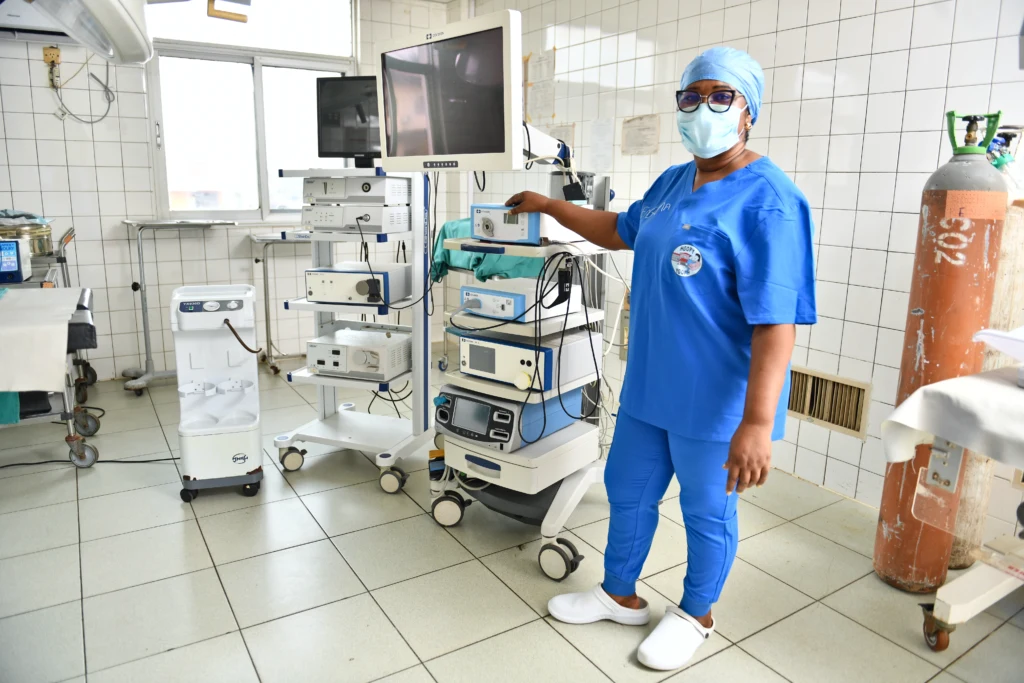
The technical heart of the hospital, where safety comes first.
Our operating suite brings together five operating theatres, including a paediatric theatre and a theatre for eye surgery, a recovery room and a central sterilisation unit. Every year, our theatre teams support thousands of operations: caesarean sections and gynaecological surgery, paediatric and general surgery, orthopaedics, ENT, eye surgery, urology and endoscopic procedures.
The theatre service is run by experienced theatre nurses and nurse anaesthetists who work with surgeons from every department. It applies strict rules on hygiene, patient identification and instrument sterilisation.
What we offer
Five operating theatres
Endoscopic surgery
Recovery room
Central sterilisation
WHO safety checklist
Training
Five operating theatres. Theatres equipped for obstetric, gynaecological, paediatric, general and eye surgery.
Endoscopic surgery. Laparoscopy, hysteroscopy, cystoscopy and colposcopy.
Recovery room. Post-operative monitoring until patients are ready to return to the ward.
Central sterilisation. Cleaning, packing and sterilisation of all surgical instruments.
WHO safety checklist. Checks before anaesthesia, before incision and before the patient leaves theatre.
Training. Theatre training for surgical residents, nurses and theatre technicians.
Preparing for your operation
Good preparation reduces the risk of complications. Your surgeon and anaesthetist will give you instructions; the most common are listed below.
Take a shower with the antiseptic soap recommended by the ward the evening before and the morning of surgery
Do not eat after the time indicated by the anaesthetist (usually from 20:00 the evening before)
Remove jewellery, make-up, nail polish and dentures
Sign the consent form after the surgeon has explained the procedure
Make sure blood donors and the required deposit are arranged when requested
Sterilisation: an invisible guarantee
Every instrument used in theatre is cleaned, inspected, packed and sterilised in our central sterilisation unit before use. The unit also supports the maternity, emergency department and outpatient clinics. Scheduled maintenance of theatre equipment and a weekly theatre coordination meeting help keep the suite safe and efficient.
Who leads the service
LELE BOMGUI Samuel – State Registered Nurse, Chief of Service, Operating Theatre
ENGAMA Jeanine Nicole – Theatre Nurse, Head Nurse of the Operating Suite
NDI BINDOUMOU Henri – Head Nurse, Sterilisation Unit
Practical information
Planned surgery. Operations are scheduled Monday to Friday. Emergencies are operated on 24/7.
Families. Relatives wait in the waiting area near the theatre entrance and are informed when the patient is in recovery.
Blood donors. The blood bank may ask for donors before major surgery.
Safety. Your identity and the planned procedure will be checked several times. This is normal and protects you.
For hygiene and safety reasons, relatives cannot enter the operating theatre. For young children, a parent may stay until the child is asleep when the team agrees.
Repeated identity checks are part of the WHO Surgical Safety Checklist and help prevent errors.
It depends on the procedure. The surgeon will give you an estimate, and the theatre team will inform your family when you are in the recovery room.
You will wake up in the recovery room, where nurses monitor you closely. You will then return to your ward, or to intensive care if needed.
Ask a question about Operating Theatres & Sterilisation
Our team replies on working days. For an emergency, do not write: call (+237) 670 607 278 or come directly to the hospital.
Book an Appointment
Choose the service, a day and a time slot.
Our team will confirm your appointment by phone or email. For emergencies, do not use this form: come directly to our emergency department or call (+237) 670 607 278.
Book an Appointment
Choose the service, a day and a time slot. Our team will confirm your appointment by phone or email. For emergencies, do not use this form: come directly to our emergency department or call (+237) 670 607 278.